What Are the 3 Types of Mirrors and How They Work in Your Home?
 Jan, 8 2026
Mirror Selection Guide
Select your mirror application to get the best recommendation:
Ever look in a mirror and wonder why your face looks different in some than others? Not all mirrors are created equal. The three main types-plane, concave, and convex-each bend light in their own way, and that changes how you see yourself, your room, or even your car’s blind spot. Knowing the difference isn’t just for science class; it affects how you pick mirrors for your bathroom, hallway, or driveway.
Plane Mirrors: The Everyday Mirror
The plane mirror is the simplest and most common type. It’s flat. You see it every morning in your bathroom, on the back of your dresser, or in a full-length closet door. Light hits it straight on and bounces back at the same angle. That’s why your reflection looks exactly like you-same size, same distance, no distortion.
These mirrors don’t magnify or shrink anything. If you stand two feet away, your reflection is two feet behind the glass. That’s why they’re perfect for checking your outfit or brushing your teeth. No surprises. No warping. Just truth.
They’re also the only type that creates a virtual image-meaning the image appears behind the glass, but you can’t touch it. That’s why you can’t catch your reflection in a plane mirror like a real person. It’s pure light, not substance.
Concave Mirrors: The Magnifier
Concave mirrors curve inward, like the inside of a spoon. This shape bends light rays toward a single point called the focal point. That’s why they’re used in makeup mirrors, dental tools, and telescope reflectors. When you stand close to one, your face looks bigger, sharper, and more detailed.
But there’s a catch: if you step too far back, the image flips upside down. That’s why you’ll never see a concave mirror in your hallway. It’s too unpredictable for everyday use. But in a bathroom vanity with built-in lighting, it’s gold. The magnification helps you spot a stray eyebrow hair or apply eyeliner without squinting.
These mirrors are also used in car headlights and satellite dishes because they focus light or radio waves into a tight beam. In your home, they’re not common-but when you find one, you know it’s there for a reason: precision.
Convex Mirrors: The Wide-Angle View
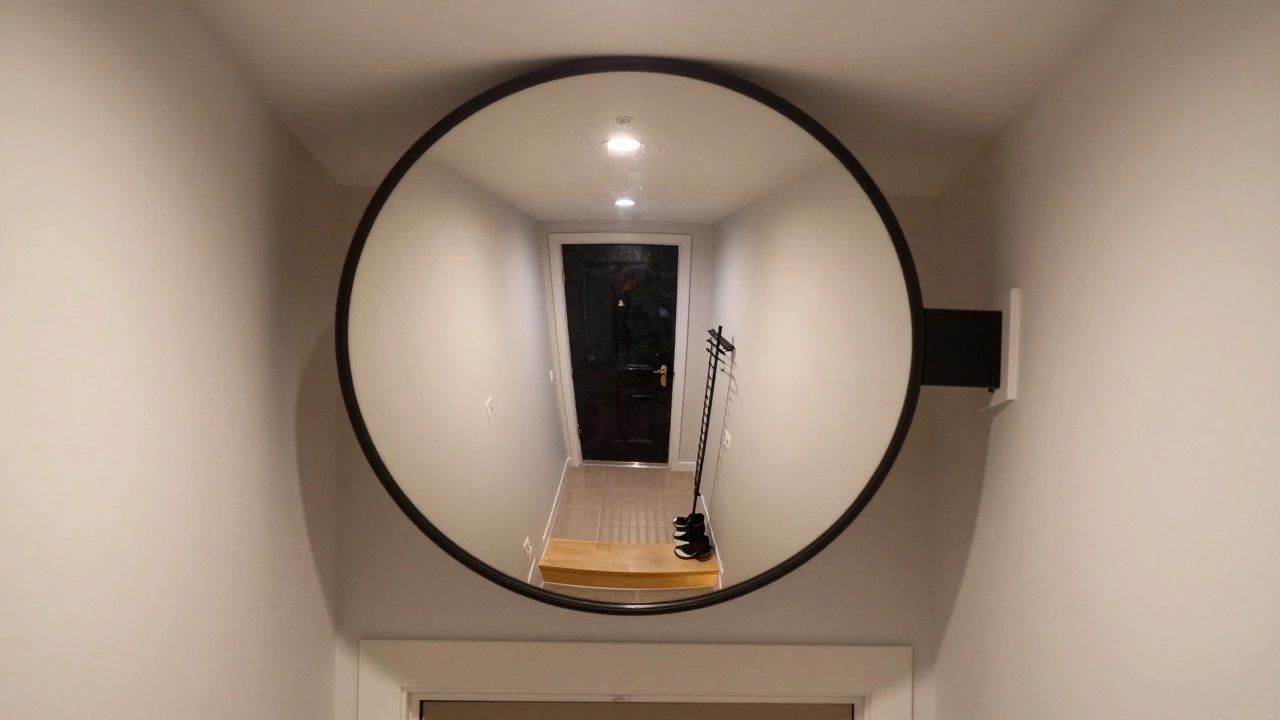
Convex mirrors bulge outward, like the back of a spoon. They spread light out instead of focusing it. That means they show a wider field of view than any flat mirror. But there’s a trade-off: everything looks smaller and farther away.
You’ve seen these in parking garages, at sharp corners in warehouses, and on the passenger side of your car. The little sticker that says “Objects in mirror are closer than they appear”? That’s because your brain trusts what it sees in a flat mirror. A convex mirror tricks your eyes into thinking things are farther off than they really are.
In homes, convex mirrors are rare-but useful. Install one at the end of a narrow hallway to see who’s coming from the living room. Put one above a front door to check who’s at the gate without opening it. They’re not for checking your hairline, but they’re perfect for safety and awareness.

Why It Matters: Choosing the Right Mirror for the Right Spot
It’s not just about style. The shape of a mirror changes how you interact with space. A plane mirror in a small bedroom makes the room feel bigger without distorting proportions. A convex mirror in a dark corner reduces blind spots. A concave mirror in a vanity gives you control over detail.
Here’s a quick guide:
- Use plane mirrors for general reflection: bathrooms, bedrooms, entryways. They’re honest, reliable, and neutral.
- Use concave mirrors when you need magnification: makeup stations, grooming areas, craft tables. Keep them close to your face.
- Use convex mirrors for safety and wide views: hallways, stairwells, driveways, garages. They help you see more, even if things look smaller.
Don’t just buy a mirror because it looks nice. Think about what you need it to do. A 30-inch plane mirror might be perfect for your bedroom, but if you’re trying to monitor your driveway, a small convex one will do more work in half the space.
Common Misconceptions
Many people think all mirrors are the same. They’re not. A cheap, curved mirror from a discount store isn’t a “fashion convex mirror”-it’s just poorly made. Real convex mirrors have a consistent, smooth curve. The same goes for concave mirrors. If the magnification feels uneven or wavy, it’s not a quality optical surface.
Another myth: mirrors make rooms bigger. Only plane mirrors do that effectively. Convex mirrors make rooms look *more open* but *smaller* in scale. Concave mirrors can make a space feel *intimate* or even *cluttered* if used wrong.
And no, mirrors don’t “reflect energy” or “improve feng shui” in any scientific way. But they *do* reflect light-and that can make a room feel brighter, calmer, or more connected to the outdoors. That’s real.
Real-World Examples from New Zealand Homes
In Auckland, where homes are often narrow and light is limited in winter, people use mirrors strategically. A large plane mirror opposite a window can double natural light in a living room. A convex mirror mounted near a steep staircase helps prevent collisions. A concave mirror in a bathroom vanity with LED lighting is a must-have for people who wear makeup or shave daily.
One homeowner in Ponsonby replaced a cracked convex mirror above her garage entrance with a new one after a neighbor backed into her fence. “I didn’t realize how much I relied on it until it was gone,” she said. “Now I see the whole driveway. No more guessing.”
Another in Christchurch uses a 12-inch concave mirror on his desk to check his posture while working. “I used to slouch,” he told me. “Now I see the curve of my back in real time. It’s like having a coach watching me.”
What to Look for When Buying
Not all mirrors are made the same. Here’s what to check:
- Glass quality: Look for low-iron glass. It’s clearer and less green-tinted than standard glass.
- Backing: Silver backing is standard, but copper-backed mirrors last longer in humid areas like bathrooms.
- Frame: If you’re buying a framed mirror, make sure the frame doesn’t warp the glass. A warped frame can create subtle distortions.
- Curvature: For convex or concave mirrors, test the curve. Run your finger along the edge. It should feel smooth, not jagged or uneven.
For concave mirrors, check the magnification level. Most home versions offer 3x to 10x. 5x is ideal for most people-strong enough to see details, not so strong it feels like a funhouse mirror.
Final Thought: Mirrors Are Tools, Not Just Decor
A mirror isn’t just something you hang to look good. It’s a tool that shapes how you see the world-literally. Whether you’re applying eyeliner, checking your blind spot, or trying to brighten a dark hallway, the type of mirror you choose changes the outcome.
Don’t treat mirrors like afterthoughts. Pick them with purpose. The right one can save you time, prevent accidents, and even improve your daily routine. And that’s more valuable than any frame.
What are the 3 types of mirrors?
The three main types are plane mirrors (flat), concave mirrors (curved inward), and convex mirrors (curved outward). Each reflects light differently: plane mirrors show true, undistorted images; concave mirrors magnify and focus; convex mirrors widen the field of view but shrink the image.
Which mirror is best for a bathroom?
For most bathrooms, a plane mirror is best for general use. But if you do makeup, shave, or apply skincare daily, add a concave mirror with 5x magnification near your sink. It gives you the detail you need without taking up extra space.
Can convex mirrors be used indoors?
Yes. Convex mirrors are great indoors for safety. Install them at the end of narrow hallways, above front doors, or near stairwells to see around corners. They’re not for checking your hair, but they help you avoid bumping into things.
Why do some mirrors make you look fatter or thinner?
That’s usually due to poor manufacturing, not mirror type. A warped frame or uneven glass can distort your reflection. True convex mirrors make everything look smaller and farther away-not fatter. True concave mirrors magnify, but only if you’re close to them. If you’re seeing weird distortions, the mirror is likely cheap or damaged.
Do mirrors really make a room look bigger?
Only plane mirrors do that effectively. They reflect light and space without altering proportions. Convex mirrors widen your view but shrink the image, making things look smaller. Concave mirrors can make a space feel tighter. For the illusion of space, use a large, flat mirror opposite a window or light source.