The 2 Laws of Reflection: Understanding How Mirrors Work
 Jul, 5 2026
Interactive Reflection Simulator
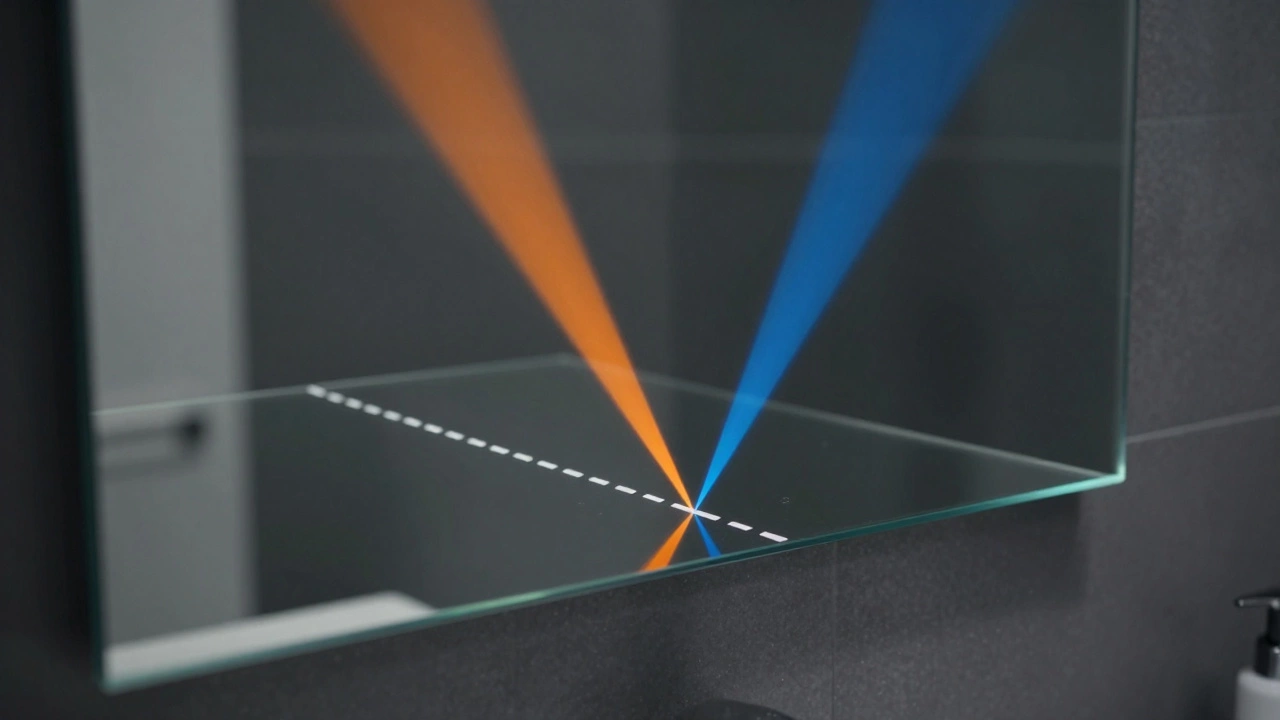
You’ve probably looked into a mirror your entire life without ever thinking about the invisible rules that make it work. You see yourself, you check your hair, and you walk away. But what if I told you that every time you look in the glass, two strict mathematical laws are being followed to the decimal? These aren’t just abstract physics concepts for textbooks; they are the reason why your reflection isn’t scrambled, why periscopes work, and how laser rangefinders measure distances across miles.
When people ask about the "laws of mirror," they are almost always referring to the Laws of Reflection. These two simple principles govern how light bounces off any smooth surface, from a polished silver mirror to a calm lake. Understanding them doesn’t require a degree in physics, but it does change how you see the world around you. Let’s break down exactly what these laws are, how they work in real life, and why they matter whether you’re designing a bathroom or building a satellite.
The First Law: The Coplanar Rule
The first law might sound technical at first glance, but it is actually quite intuitive once you visualize it. It states that the incident ray (the light hitting the mirror), the reflected ray (the light bouncing off), and the normal line all lie in the same plane.
To understand this, we need to define three key terms:
- Incident Ray: This is the beam of light traveling from an object toward the mirror.
- Reflected Ray: This is the beam of light bouncing off the mirror and entering your eye.
- The Normal: This is an imaginary line drawn perpendicular (at a 90-degree angle) to the surface of the mirror at the exact point where the light hits.
Imagine you are standing on a flat floor holding a flashlight. If you shine the light straight down, it hits the floor and bounces straight back up. All three lines-the incoming light, the outgoing light, and the vertical normal line-are stacked directly on top of each other. They exist in one single, flat slice of space. Now, tilt the flashlight to the side. The light hits the floor, bounces off to the right, and the normal line stands straight up. Even though the angles have changed, all three lines still exist within the same flat sheet of paper if you were to draw them out. They never twist out of that plane.
This law ensures predictability. If light could bounce off in a random third dimension-say, jumping sideways when it hit the mirror-your reflection would be distorted beyond recognition. The coplanar rule keeps the geometry stable, ensuring that the image you see corresponds directly to the physical position of the object.
The Second Law: Equal Angles
If the first law sets the stage, the second law provides the action. This is the one most people remember from school. It states that the angle of incidence is equal to the angle of reflection.
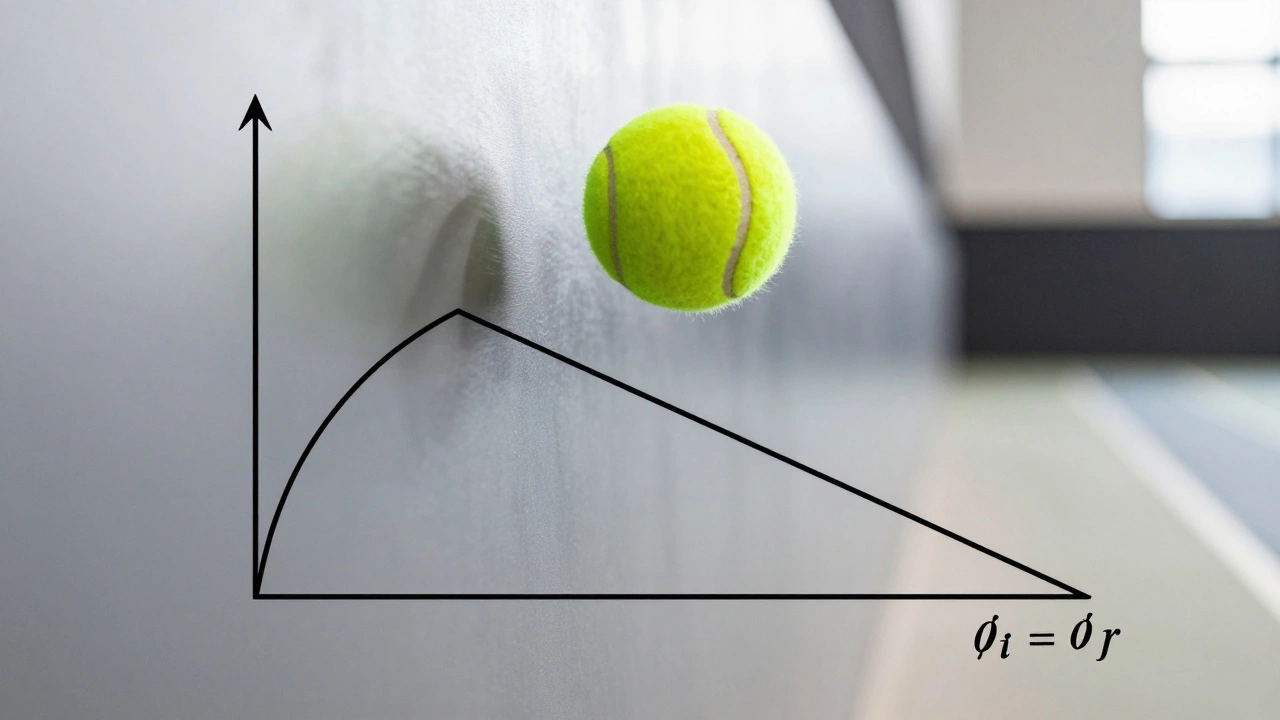
Mathematically, this is written as θi = θr. Here, θi represents the angle between the incident ray and the normal, and θr represents the angle between the reflected ray and the normal. Crucially, these angles are measured from the normal line, not from the surface of the mirror itself. This distinction matters because measuring from the surface can lead to calculation errors in complex optical systems.
Think of a tennis ball bouncing off a wall. If you throw the ball at a 45-degree angle relative to the wall’s perpendicular axis, it will bounce off at a 45-degree angle on the other side. Light behaves exactly the same way, except it moves much faster and doesn’t lose energy to friction. If you shine a laser pointer at a mirror at a 30-degree angle from the normal, the light will reflect at exactly 30 degrees. Not 29, not 31. Exactly 30.
This symmetry is what creates clear images. Because every single photon bouncing off your face follows this rule perfectly, your brain can reconstruct the scene accurately. If the angles varied randomly, the light rays would scatter, and instead of seeing your face, you’d see a blur of colors. This type of scattering is called diffuse reflection, which happens on rough surfaces like paper or unpolished wood. Mirrors work because their surface is smooth enough at the microscopic level to maintain specular reflection, where parallel rays remain parallel after bouncing.
Why Smooth Surfaces Matter
The laws of reflection apply to all surfaces, but the result depends entirely on texture. A mirror is not magic; it is simply very smooth. When we say a surface is smooth, we mean that its irregularities are smaller than the wavelength of visible light. Visible light has wavelengths between 380 and 700 nanometers. If the bumps on a surface are larger than this, light hits different parts of the bump at different angles. Since the normal line changes direction at every tiny bump, the reflected rays scatter in many directions.
This is why you can see your reflection in a calm pond but not in choppy water. The water molecules are moving, creating peaks and valleys that act like thousands of tiny, angled mirrors. Each patch reflects light according to the laws of reflection, but because the angles are different everywhere, the image breaks apart. In contrast, a glass mirror has a layer of aluminum or silver applied with atomic precision. The surface is so flat that the normal line is effectively the same across the entire reflective area. This uniformity allows the laws of reflection to produce a coherent image.
Understanding this helps explain why cleaning your mirror matters. Dust and smudges create micro-roughness. While they don’t break the laws of physics, they do introduce local variations in the normal line, causing slight scattering. This reduces the contrast and clarity of your reflection. A clean mirror maximizes specular reflection, giving you the sharpest possible view.
Real-World Applications Beyond Your Bathroom
You might think these laws only apply to vanity mirrors, but they are fundamental to modern technology. Consider the periscope used in submarines. It uses two mirrors placed at 45-degree angles. Light enters the top mirror, reflects down the tube at a 90-degree turn, hits the bottom mirror, and reflects again at another 90-degree turn into the viewer’s eye. This works purely because the angle of incidence equals the angle of reflection. Without this predictable behavior, navigation would be impossible underwater.
Laser scanners and LiDAR (Light Detection and Ranging) systems rely on the same principle. These devices emit pulses of light and measure how long it takes for the light to bounce back. By knowing the speed of light and the angle of reflection, computers can map out environments in 3D. Self-driving cars use LiDAR to detect pedestrians, other vehicles, and obstacles. If the laws of reflection were inconsistent, these safety systems would fail, leading to dangerous miscalculations of distance and position.
Even solar power plants use giant arrays of curved mirrors to concentrate sunlight onto a central tower. The curvature is calculated precisely using the laws of reflection to ensure that all incoming rays converge at a single focal point. This generates intense heat to produce electricity. The efficiency of these plants depends entirely on maintaining the correct angles so that no light is wasted.
| Feature | Specular Reflection (Mirrors) | Diffuse Reflection (Paper/Wall) |
|---|---|---|
| Surface Texture | Smooth at microscopic level | Rough at microscopic level |
| Normal Line Consistency | Uniform across surface | Varies at every point |
| Image Formation | Clear, distinct image | No image, scattered light |
| Angle Relationship | θi = θr for all rays | θi = θr locally, but globally scattered |
| Common Examples | Mirrors, calm water, polished metal | Paper, cloth, unpolished wood |
Common Misconceptions About Mirror Physics
One common myth is that mirrors flip images left-to-right. They don’t. Mirrors flip images front-to-back. When you raise your right hand, your reflection raises the hand on the right side of the glass. However, because the reflection is facing you, it appears as if it’s raising its left hand. This is a perspective issue, not a physical flipping of the image. The laws of reflection treat the horizontal and vertical axes equally. There is no special rule that says "flip left and right." The confusion arises because we rotate ourselves mentally to match the reflection, which creates the illusion of a lateral swap.
Another misconception is that dark rooms prevent reflections. Mirrors do not generate light; they only redirect it. If there is no light source in the room, there is no incident ray to reflect. That’s why you can’t see anything in a pitch-black room, even with a mirror. Conversely, in a brightly lit room, the mirror reflects whatever light is present. This is why photographers often use large mirrors or reflectors to bounce natural light onto subjects, softening shadows and improving exposure. They are manipulating the path of light using the second law of reflection.

How to Test the Laws Yourself
You don’t need a lab to verify these laws. Grab a small handheld mirror, a laser pointer, and a protractor. Shine the laser at the center of the mirror at an angle. Mark the point where the laser hits. Draw a line perpendicular to the mirror surface at that point-this is your normal. Measure the angle between the incoming laser beam and the normal. Then, measure the angle between the reflected beam and the normal. You will find they are identical. Try changing the angle and repeating the test. The relationship holds true every time.
This simple experiment demonstrates the reliability of optical physics. It also shows why precision matters in engineering. If you were building a telescope, a deviation of even a fraction of a degree would cause the image to drift out of focus. The laws of reflection provide the foundation for everything from simple bathroom accessories to complex astronomical instruments.
Summary of Key Points
The two laws of reflection are the backbone of geometric optics. The first law ensures that light stays within a predictable plane, while the second law guarantees that angles are preserved during reflection. Together, they allow us to create clear images, navigate underground, scan environments with lasers, and harness solar energy. Whether you are adjusting a rearview mirror or designing a satellite dish, these principles remain constant. They are simple, elegant, and absolutely essential to how we interact with light.
What are the two laws of reflection?
The first law states that the incident ray, reflected ray, and normal all lie in the same plane. The second law states that the angle of incidence is equal to the angle of reflection.
Do mirrors flip images left to right?
No, mirrors flip images front to back. The perception of left-right reversal is due to human perspective and mental rotation, not the physics of reflection.
Why can't I see my reflection in a rough wall?
Rough surfaces cause diffuse reflection. The microscopic irregularities change the normal line at every point, scattering light in many directions instead of reflecting it coherently.
Is the angle measured from the mirror surface or the normal?
The angle is always measured from the normal, which is an imaginary line perpendicular to the surface at the point of incidence.
How do periscopes use the laws of reflection?
Periscopes use two mirrors set at 45-degree angles. Light reflects off the first mirror, travels down the tube, and reflects off the second mirror into the viewer's eye, allowing sight around obstacles.