What Is the Most Comfortable Sofa? Real-World Picks That Actually Feel Good
 Dec, 11 2025
Sofa Comfort Calculator
Find Your Perfect Sofa
Answer a few questions about your height and sitting preferences to get personalized recommendations for the most comfortable sofa for you.
Your Comfort Recommendation
Ideal Seat Depth
The article recommends seat depths between 21-25 inches for optimal comfort.
Key Features to Look For
Recommended Sofa Types
Avoid These Mistakes
There’s no such thing as the most comfortable sofa-not really. What feels like heaven to one person feels like a brick wall to another. Your height, your weight, how you sit, whether you like to sink in or sit up straight-all of it changes everything. So instead of chasing a single answer, let’s cut through the noise and find out what actually makes a sofa comfortable for real people, not just showroom models.
Comfort Isn’t About Brand Names
You’ve seen the ads: luxury brands with names you can’t pronounce, claiming their sofa is "engineered for ultimate relaxation." But here’s the truth: a $10,000 Italian sectional won’t feel better than a $1,200 one if the cushion density is wrong. Comfort comes down to three things: cushion fill, frame construction, and seat depth. Not the logo on the tag.Take memory foam. It’s popular because it hugs your body. But low-density memory foam collapses after six months. High-density memory foam-1.8 lbs/ft³ or higher-holds its shape. That’s what you want. Same with down blends. Real down (not just "down alternative") mixed with high-resilience foam gives you that cloud-like feel without turning into a pancake by Tuesday.
Seat Depth Matters More Than You Think
Most people sit too far forward on their sofas. They’re perched on the edge, legs dangling, back unsupported. That’s not relaxing-it’s straining. The sweet spot? A seat depth between 21 and 25 inches. Anything less than 20 inches feels like sitting on a stool. Anything over 27 inches and you’re sliding backward, needing pillows just to stay upright.If you’re taller than 5’10", go for 24-25 inches. Shorter? Stick to 21-22. Test this: sit on the sofa and let your back rest naturally against the backrest. Your knees should be slightly bent, feet flat on the floor. If your legs are straight out or tucked under you, it’s not the right fit.
Backrest Height and Angle Are Secret Players
A low backrest might look sleek, but if you’re over 5’6", your spine will be unsupported. Your lower back will ache after 20 minutes. Look for a backrest that reaches at least mid-back-around 22 inches from the seat. For full support, especially if you like to recline, choose one that hits just below your shoulder blades.Angle matters too. A slight recline of 10-15 degrees feels natural. Flat-backed sofas force you to sit upright, which is fine if you’re reading or working. But if you’re watching TV or napping, you need a gentle slope. Some high-end sofas have adjustable backrests. If you can’t adjust it, test it in person. Sit back. Does your spine feel aligned? Or are you hunched?

Frame and Suspension: The Hidden Backbone
You can have the softest cushions in the world, but if the frame is weak, it’ll sag within a year. Look for kiln-dried hardwood frames-oak, maple, or beech. Avoid particleboard or plywood. They warp. Check the joints: they should be glued and screwed, not just stapled.Suspension is where most cheap sofas fail. Webbing (those stretchy straps under the seat) is okay for light use, but if you’re sitting on it daily, go for eight-way hand-tied springs. They’re expensive, yes, but they last 20+ years and give even support across the whole seat. No sinking in the middle. No creaking when you shift.
Real People, Real Sofas: What Works in 2025
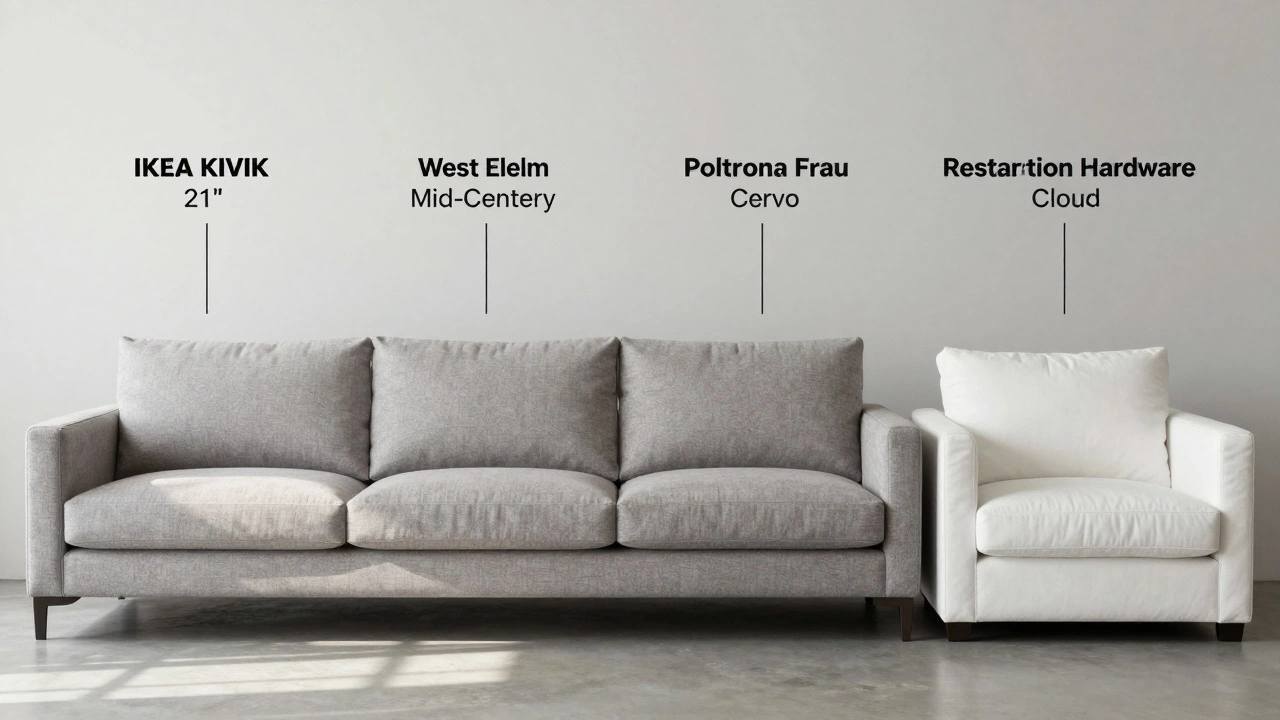
Here’s what’s actually being bought by people who sit on their sofas for hours every day:- Restoration Hardware’s Cloud Sofa: Deep seat (24”), high-density foam with down wrap. Feels like sitting on a marshmallow-but stays firm. Best for tall people and those who love to lounge.
- West Elm’s Mid-Century Sofa: Firm foam core with a slight give. 22” seat depth. Great for smaller spaces and people who sit upright. Durable, easy to clean, and doesn’t look like a couch from 1998.
- IKEA KIVIK: Surprisingly good. High-resilience foam, removable covers, and a 23” seat depth. At $1,199 for a three-seater, it’s the most common pick among renters and young families. Lasts 5+ years with daily use.
- Poltrona Frau’s Cervo Sofa: For those who want luxury that lasts. Hand-stitched, full-grain leather, 25” seat depth. Uses a proprietary blend of memory foam and latex. Comes with a 25-year warranty. Not cheap, but it’s a lifetime piece.
Notice something? None of these are "designer" names that scream luxury. They’re built for function. The ones people keep for a decade.
What to Avoid at All Costs
Don’t buy a sofa that:- Has no visible frame-just fabric stretched over foam. That’s a coffin, not a couch.
- Uses only polyester fiberfill. It flattens faster than a balloon losing air.
- Has a seat depth under 20 inches. You’ll feel like you’re sitting on the edge of a bed.
- Is labeled "machine-tied" or "serpentine springs." They’re okay for occasional use, not daily life.
- Doesn’t let you test it for at least 10 minutes. If the store won’t let you sit, walk out.
Test Like a Pro
Before you buy, do this:- Sit down and stay there for 10 minutes. No checking your phone. Just feel.
- Lean back. Does your lower back feel supported? Or are you slumping?
- Stand up. Does the cushion spring back immediately, or does it stay flattened?
- Press your hand into the cushion. Can you feel the frame underneath? If yes, the foam is too thin.
- Ask for the density specs. If they don’t know, walk away.
Comfort isn’t a feeling you get after five seconds. It’s a feeling you get after five minutes. If you’re still happy after ten, you’ve found it.
Final Thought: Comfort Is Personal
There’s no single "best" sofa. But there is a best one for you. It’s the one that lets you sink in without disappearing, supports your back without forcing you upright, and still feels like home after five years of movie nights, dog cuddles, and midnight snacks.Don’t chase trends. Don’t fall for marketing. Sit on it. Live with it for a few minutes. If your body says yes, that’s the one.
What’s the best sofa for tall people?
Tall people need a seat depth of 24 to 25 inches and a backrest that reaches at least mid-back. Look for sofas like the Restoration Hardware Cloud or Poltrona Frau Cervo. Avoid low-back, shallow-seated models-they’ll force you to hunch or slide forward.
Are memory foam sofas worth it?
Only if the foam is high-density (1.8 lbs/ft³ or higher). Low-density memory foam flattens in under a year. High-density foam molds to your body and rebounds slowly, giving long-term support. Pair it with a down blend for softness without sinking too far.
How long should a comfortable sofa last?
A well-built sofa with a hardwood frame and eight-way hand-tied springs can last 15 to 25 years. Cheaper sofas with particleboard frames and serpentine springs start sagging after 3 to 5 years. The cushion fill matters too-high-resilience foam lasts longer than polyester fiberfill.
Is a deep seat always better?
Not if you’re short. A seat deeper than 25 inches can make you feel like you’re sliding backward, forcing you to use pillows for support. For people under 5’6", 21-22 inches is ideal. For taller people, 24-25 inches gives room to stretch out without losing back support.
Can I make my current sofa more comfortable?
Yes. Add a high-loft cushion topper made of memory foam or down blend. Replace flat seat cushions with ones that have a higher density foam core. Use a lumbar pillow if your back feels unsupported. And if the frame is still solid, reupholstering with better padding can extend its life by a decade.