What is the slang for a $50 bill? A quick guide to money nicknames
 May, 7 2026
Money Slang Decoder
Select a bill below to reveal its common slang terms and historical context.
Click any bill above to see details.
You pull out a crisp fifty-dollar bill is a United States paper currency note featuring Ulysses S. Grant on the front at the checkout counter. The cashier looks at it, and you wonder if there’s a cooler way to refer to it than just “fifty bucks.” Money has always had a colorful language attached to it. From the early days of American banking to modern street culture, people have invented creative names for their cash. Understanding these terms isn’t just about sounding cool; it’s about understanding the cultural history behind the money in your wallet.
The most common slang for a $50 bill is simply “fifty.” But that’s just the start. You might hear it called a “Grant” because Ulysses S. Grant is printed on the front. In some circles, especially those influenced by hip-hop or urban culture, you’ll hear it referred to as a “Franklin” - wait, no, that’s actually a $100 bill (Benjamin Franklin). Confusion between denominations is common, so let’s clear it up. For a $50 bill, the nickname “Grant” is accurate but less commonly used in casual conversation compared to “Hamilton” for the $10 or “Lincoln” for the $5.
Why Do We Use Slang for Money?
Money slang serves several purposes. Historically, it was a way to discreetly discuss wealth without attracting unwanted attention. Today, it’s often about identity and belonging. Using specific terms can signal that you’re part of a particular group, whether that’s musicians, traders, or just friends who hang out together. It adds flavor to everyday transactions. Saying “I’ve got a stack of Grants” sounds more vivid than “I have several fifty-dollar bills.”
The origins of many money nicknames are rooted in the portraits on the bills. This makes sense when you think about it. Each denomination features a different historical figure, and naming the bill after them creates a direct link between the person and the value. For example, the $1 bill is often called a “single” or a “buck,” while the $20 bill is frequently referred to as a “Jackson” after Andrew Jackson.
Common Nicknames for the $50 Bill
While “fifty” is the standard term, there are a few other ways people refer to this bill:
- Grant: Named after Ulysses S. Grant, the 18th President of the United States. This is the most accurate descriptive nickname.
- Fifty-buck piece: A slightly older, more formal-sounding slang term.
- Half-hundred: Used occasionally, though less common than “half-stack” which usually refers to $500.
- Big G: Sometimes used in contexts where “G” stands for grand ($1,000), but this can be confusing.
It’s worth noting that unlike the $100 bill (“C-note”) or the $20 bill (“Deuce”), the $50 bill doesn’t have a single, universally recognized slang term that dominates all others. This lack of a dominant nickname might be because the $50 bill is less frequently used in large-scale transactions compared to higher denominations.
How $50 Bills Compare to Other Denominations
| Denomination | Portrait | Common Slang | Origin/Reason |
|---|---|---|---|
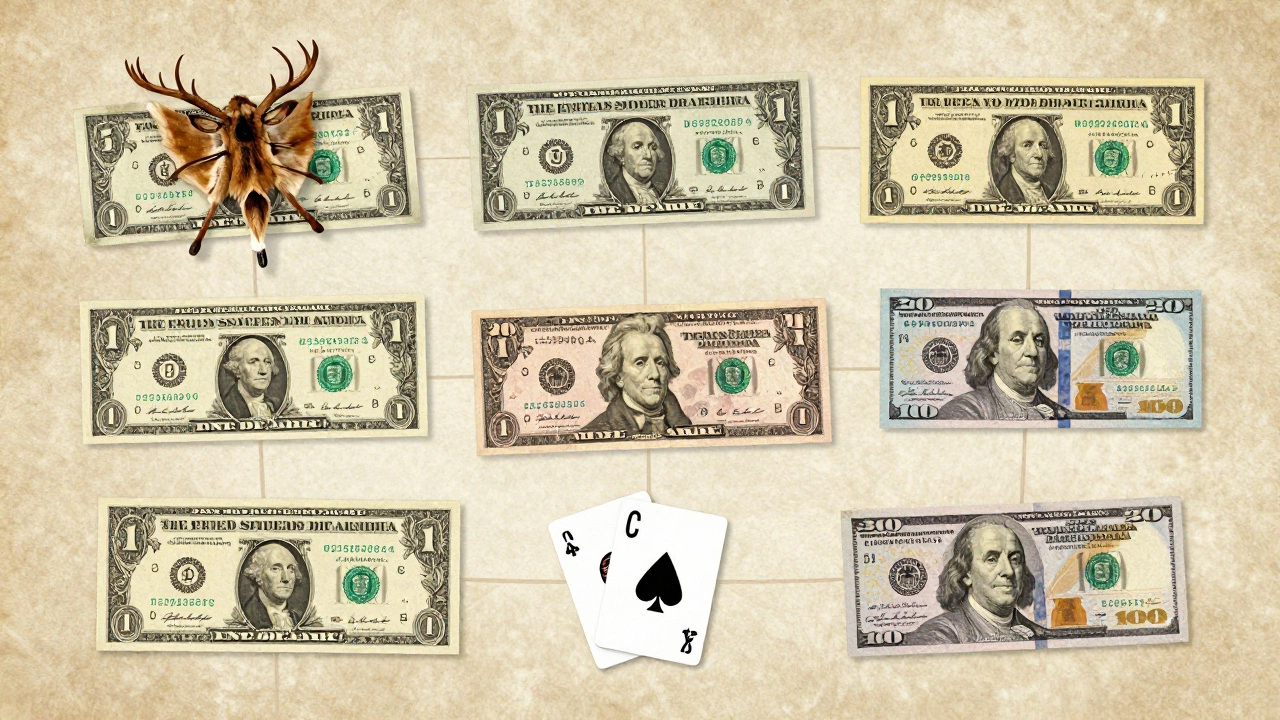
| $1 | George Washington | Buck, Single, One | “Buck” comes from deer skins used as currency in early America. |
| $5 | Abraham Lincoln | Lincoln, Five-spot | Named after the president depicted. |
| $10 | Alexander Hamilton | Hammer, Tenner | “Hammer” is a play on Hamilton’s name. |
| $20 | Andrew Jackson | Jackson, Deuce | “Deuce” comes from playing cards (the number two). |
| $50 | Ulysses S. Grant | Grant, Fifty | Named after the president depicted. |
| $100 | Benjamin Franklin | C-note, Benjamin, Benjy | “C-note” comes from Roman numeral C (100). |
The Cultural Impact of Money Slang
Money slang appears everywhere in popular culture. Hip-hop lyrics are filled with references to “bands,” “stacks,” and specific bill names. Movies and TV shows use these terms to create atmosphere and character depth. When a character says they need “some Grant,” it tells you something about their background and attitude toward money.
In business settings, however, clarity is key. While you might hear “five-spot” in a casual office environment, you wouldn’t want to use slang in a formal financial report. Knowing when to use slang and when to stick to plain language is an important social skill. It shows awareness of context and audience.
Are There Regional Differences?
Yes, regional variations exist. In New Zealand, where I live, we don’t use US dollars, so our slang is different. We call our $50 note a “fifty” or sometimes a “Grant” jokingly, referencing the US bill. In Australia, similar patterns emerge. The point is that money slang is local. What works in New York might not make sense in Auckland or London.
If you’re traveling internationally, be careful with slang. Using US-specific terms like “Grant” or “C-note” in Europe could lead to confusion. Always clarify the actual amount when dealing with foreign currencies.

How to Use Money Slang Effectively
To use money slang effectively, follow these simple guidelines:
- Know your audience: Only use slang with people who understand it.
- Keep it natural: Don’t force slang into every sentence. It should flow naturally.
- Avoid ambiguity: If there’s any chance of misunderstanding, spell out the amount.
- Be aware of context: Slang is fine in casual conversations but inappropriate in formal documents.
For instance, saying “I’ll give you my last Grant” to a friend is perfectly fine. But writing “Payment: one Grant” on a check would be unprofessional and potentially confusing.
Final Thoughts on Money Language
Language evolves constantly, and money slang is no exception. New terms emerge, old ones fade, and some become classics. The $50 bill may not have the most iconic nickname, but its place in our monetary system is secure. Whether you call it a “Grant,” a “fifty,” or just “cash,” it’s still valuable.
Understanding these terms enriches your vocabulary and connects you to the broader cultural narrative around money. So next time you’re holding a $50 bill, take a moment to appreciate not just its purchasing power, but also the stories embedded in its name.
What is the most common slang for a $50 bill?
The most common slang for a $50 bill is simply "fifty." Another accurate but less frequent term is "Grant," named after Ulysses S. Grant whose portrait appears on the bill.
Is "Franklin" slang for a $50 bill?
No, "Franklin" refers to the $100 bill, which features Benjamin Franklin. The $50 bill features Ulysses S. Grant, so it's sometimes called a "Grant."
Why is the $100 bill called a "C-note"?
The term "C-note" comes from the Roman numeral C, which represents 100. This naming convention dates back to older banknotes that included letter codes for denominations.
Can I use money slang in formal situations?
It's generally not recommended to use money slang in formal situations like legal documents, financial reports, or official communications. Stick to clear, unambiguous terms like "fifty dollars" in such contexts.
Does the $50 bill have a unique slang term like other denominations?
Unlike the $100 bill ("C-note") or the $20 bill ("Deuce"), the $50 bill doesn't have a single, universally recognized slang term. "Grant" is the closest, but it's not as widely used as slang for other denominations.