Where Did the Term Bedding Come From? A History of Sleep
 Jun, 28 2026
Bedding Evolution Timeline
Click on any era below to explore how bedding materials, terminology, and comfort levels evolved throughout human history.
Pre-History
Before 10,000 BCEAncient Civilizations
3000 BCE - 500 CEMedieval Era
500 - 1500 CEIndustrial Revolution
1760 - 1900Modern Era
1900 - PresentFuture Trends
SustainabilitySelect an Era
Click on a time period above to learn about bedding evolution
Key Characteristics
Explore how human sleeping habits have transformed over thousands of years, from survival-focused insulation to luxury comfort systems.
Materials Used
Social Context
Comfort Level
Basic insulation from ground cold
Accessibility
Fun Fact
The phrase "jumping out of bed" likely originated from uncomfortable medieval straw mattresses!
Have you ever paused while folding a fitted sheet to wonder where the word bedding actually comes from? It feels like one of those words we use every day without thinking-until you try to define it. Is it just the mattress? The pillows? Or is it that entire stack of cotton and linen that turns a wooden frame into a sanctuary?
The answer isn’t as simple as pointing to a dictionary definition. To understand where the term comes from, we have to dig into the dirt, the stone, and eventually, the fabric of human history. The word itself is a linguistic fossil, preserving layers of how our ancestors slept, what they valued, and how their relationship with comfort evolved over thousands of years.
The Linguistic Roots: Old English Origins
Let’s start with the language itself. The word "bedding" is derived from the Old English word bæd, which meant a raised structure for resting or sleeping. This root is shared across many Germanic languages-the Dutch bed, the German Bett, and the Scandinavian variations all trace back to this same Proto-Germanic ancestor.
In its earliest forms, "bedding" didn't refer to the soft textiles we associate with luxury today. Instead, it referred to the act of making a bed or the materials used to construct the sleeping surface itself. In Middle English, the suffix "-ing" was often added to verbs to create nouns indicating an action or a result. So, "bedding" originally described the process of preparing a place to sleep. It was functional, not decorative.
This linguistic shift mirrors a practical reality. For most of human history, people didn't own separate sets of linens. You didn't have "guest bedding" versus "everyday bedding." You had what you had. The term evolved to encompass the collection of items-mattresses, straw, blankets, and later, sheets-that constituted the sleeping environment.
Pre-History: Sleeping on Straw and Stone
To truly grasp the origin of the concept, we have to look at what came before the word. Archaeological evidence suggests that early humans slept on piles of leaves, animal skins, or straw mats. These weren't "beds" in the modern sense; they were temporary shelters from the cold ground.
Consider the Lascaux caves in France. While famous for their paintings, excavations also revealed sleeping areas lined with moss and bark. This was the primal form of bedding: insulation. The primary goal wasn't comfort in the way we think of it now-it was survival. Keeping body heat away from the freezing earth was the only metric that mattered.
As societies settled into agrarian communities around 10,000 BCE, the concept of a permanent bed began to take shape. We see evidence of woven reed mats in ancient Egypt and China. These mats provided a barrier between the sleeper and pests, moisture, and rough terrain. This is the first major evolutionary step in bedding: the introduction of a manufactured layer between the human and the ground.
Ancient Civilizations: The Rise of Luxury Linens
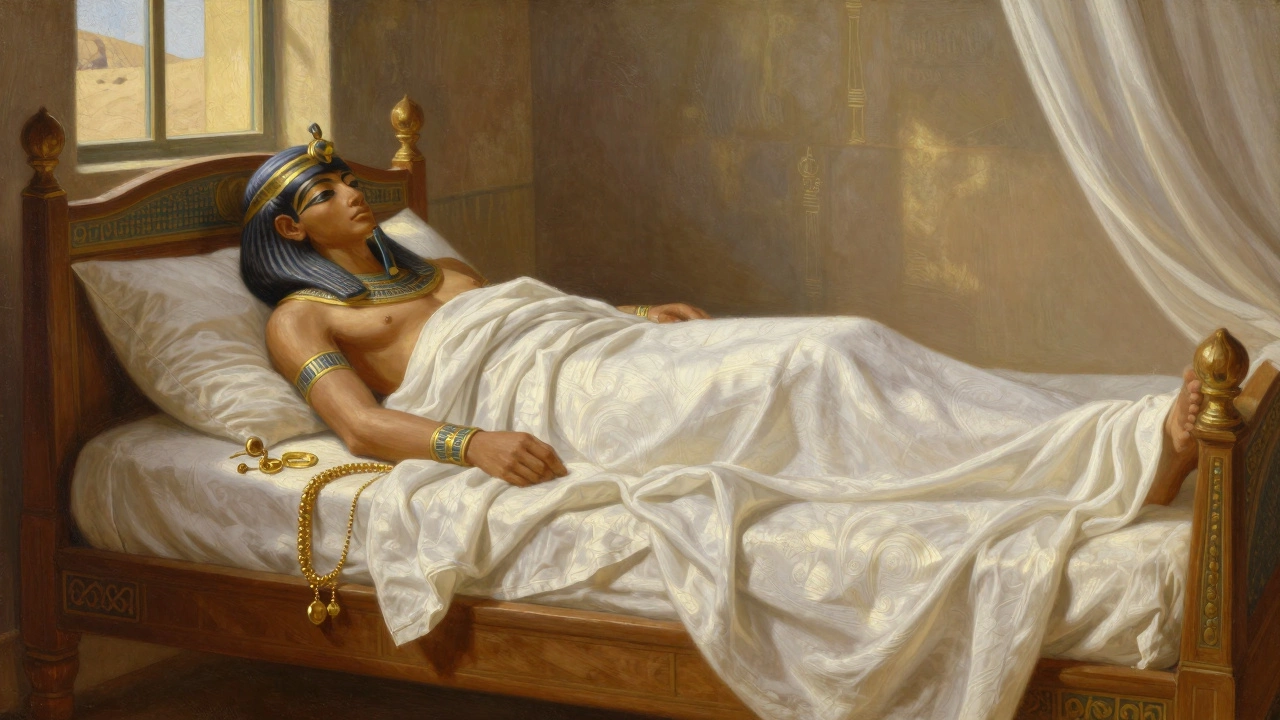
If prehistoric bedding was about survival, ancient civilization introduced the element of status. In Ancient Egypt, linen became highly prized. They developed sophisticated weaving techniques to produce fine, breathable fabrics that could withstand the desert heat. Egyptian pharaohs slept on beds draped in white linen, often adorned with gold jewelry and amulets.
This era marks a crucial pivot in the definition of bedding. It ceased to be just about warmth and started being about hygiene and social standing. Clean linen signaled wealth because producing it was labor-intensive. If you could afford fresh sheets, you were elite. This dynamic persists today, though the metrics have shifted from rarity to thread count and material quality.
Meanwhile, in Ancient Rome, bedding took on a more communal and varied form. Romans used wool blankets for warmth during colder months and lighter linens in summer. Interestingly, Roman beds were often double-sized, reflecting cultural attitudes toward intimacy and companionship. The term "bedding" here would have included the heavy woolen covers known as culcita, which served as both mattress and blanket.
The Medieval Era: Shared Spaces and Feather Beds
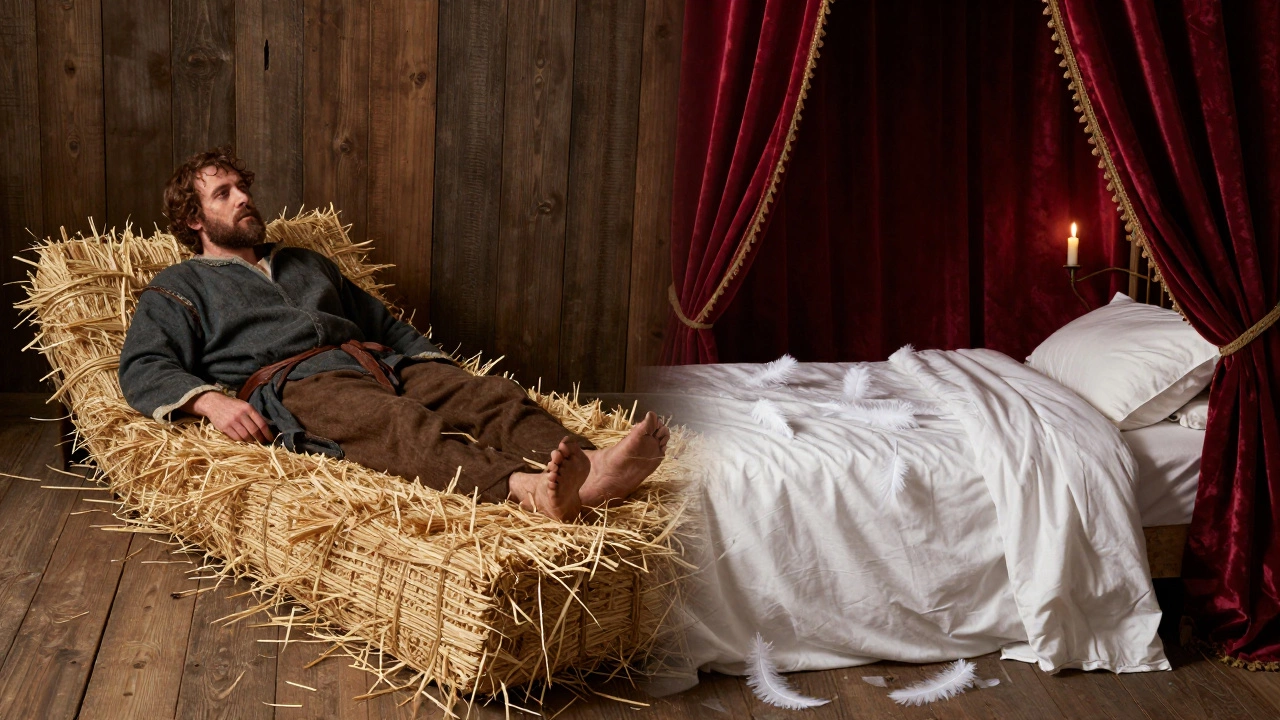
Jump forward to the Middle Ages in Europe, and the story of bedding becomes darker and more crowded. For the vast majority of the population, "bedding" meant a sack filled with straw or chaff. These sacks were stuffed annually, often leading to infestations of lice and fleas. The phrase "jumping out of bed" likely has literal roots in this uncomfortable reality.
However, for the nobility, things looked very different. The wealthy began using feather beds-mattresses stuffed with goose or duck down. This was a revolutionary development in comfort. Down provides superior insulation and conforms to the body, offering a level of support that straw simply couldn't match. The term "featherbed" entered the lexicon during this period, becoming synonymous with extreme comfort and laziness.
Medieval bedrooms were also multi-purpose rooms. Families, servants, and even pets might share a single large bed. Bed curtains, made of heavy velvet or wool, were essential not just for privacy but for trapping body heat. These curtains are a direct ancestor of the four-poster beds we romanticize today. The "bedding" ensemble included the mattress, the coverlets, the sheets, and the enclosing drapes.
The Industrial Revolution: Democratizing Comfort
For centuries, owning multiple sets of clean sheets was a luxury reserved for the rich. Changing sheets required washing by hand, drying outdoors, and ironing-a massive undertaking. Most households owned one set of good sheets and a raggedy backup. They washed them only when absolutely necessary, relying on sunlight and airing out to manage odors.
The Industrial Revolution changed everything. The invention of the spinning jenny and the power loom in the late 18th century drastically reduced the cost of cotton production. Cotton, previously a rare import, became affordable for the middle class. This led to the proliferation of white cotton sheets. Why white? Because bleaching technology improved, and white showed cleanliness. It became a visual marker of hygiene and respectability.
Suddenly, "bedding" transformed from a static, rarely-changed asset into a consumable household item. People began to expect fresh sheets weekly. The terminology expanded to include specific terms like "fitted sheets," "pillowcases," and "duvets," each describing a specialized component of the sleep system. The word "bedding" now referred to a coordinated set of goods rather than a hodgepodge of scraps.
Modern Semantics: What Does Bedding Mean Today?
Today, when we say "bedding," we usually mean the removable textile components of a bed. This includes:
- Sheets: Fitted and flat sheets that cover the mattress.
- Pillowcases: Protective covers for pillows.
- Duvet Covers or Comforters: The top layer providing warmth.
- Blankets: Additional layers for insulation.
Noticeably absent from this list are the mattress and the pillows themselves. In retail and interior design, "bedding" is distinct from "sleep systems." You buy a mattress from a specialist, but you buy bedding from a department store or home goods retailer. This distinction reflects the modern understanding of bedding as decor and hygiene, rather than structural support.
The semantic scope has also broadened to include aesthetic considerations. Bedding is no longer just about warmth; it's about color coordination, texture, and brand identity. Terms like "hotel-quality bedding" evoke a specific standard of crispness and durability. The word carries connotations of hospitality and care.
Why Etymology Matters for Your Sleep
You might be wondering why any of this history matters when you're trying to choose between percale and sateen. Understanding the origins of bedding helps us appreciate what we've gained. We’ve moved from sleeping on straw-infested sacks to choosing between organic cotton and bamboo blends based on breathability and environmental impact.
The evolution of the word mirrors the evolution of human health. As bedding became cleaner and more comfortable, sleep quality improved. Better sleep led to better productivity and longevity. The humble sheet is a testament to human ingenuity in solving the basic problem of rest.
Next time you tuck yourself in, remember that you are participating in a ritual that spans millennia. You are using tools refined by Egyptians, industrialized by Victorians, and optimized by modern engineers. The term "bedding" is small, but the history behind it is enormous.
What is the difference between bedding and linens?
While often used interchangeably, there is a subtle distinction. "Linens" traditionally refers to products made from linen fabric (flax) or high-quality cotton, including towels, napkins, and tablecloths. "Bedding" specifically refers to items used on a bed, such as sheets, duvets, and pillowcases. However, in modern retail, "bed linens" is a common category that encompasses all textile items used for sleeping.
Did people really sleep in straw mattresses?
Yes, for much of European history, particularly among the lower classes, straw mattresses were the norm. These were essentially sacks filled with dried grass or chaff. They were cheap and easy to replace but offered poor support and harbored insects. Wealthier individuals used feather beds or horsehair mattresses, which provided better comfort and hygiene.
When did fitted sheets become popular?
Fitted sheets, with elastic corners, were invented in the early 20th century but didn't become widely adopted until after World War II. Before that, flat sheets were tucked in tightly, a skill known as "hospital corners." The rise of standardized mattress sizes and the convenience of elastic made fitted sheets the dominant choice in mid-century America.
Why is white bedding associated with hotels?
White bedding signals cleanliness and uniformity. It allows stains and wear to be easily visible, ensuring that guests receive fresh, sanitized linens. Historically, white also indicated wealth because maintaining bright white fabrics required significant effort in bleaching and laundering. Hotels adopted this standard to convey luxury and hygiene to travelers.
How has the material of bedding changed over time?
Bedding materials have evolved from natural, locally sourced options like straw, wool, and hemp to globally traded luxuries like cotton and silk. In the modern era, synthetic fibers like polyester and microfiber have entered the market due to their affordability and durability. Recently, there has been a resurgence in interest in sustainable materials like organic cotton, bamboo, and Tencel, driven by environmental concerns.